
The usual advice is to blast aphids off with a garden hose. On an apartment balcony, the nearest tap may be in the kitchen. A small herb pot might fit under the faucet. A vegetable plant tied to a trellis probably won’t.
You can still manage aphids without a hose. Start by checking whether the plant needs help, then choose a method that lets you reach the insects without damaging the growth or creating a cleanup problem. A few exposed clusters may be manageable by hand. A badly infested shoot may be suitable for pruning. A labeled treatment is an option when simpler methods aren’t enough and you can apply it properly.
Before buying anything, look underneath the leaves and decide where you could do the work.
Check the insects and the plant before treating
Look for the insects themselves. Aphids are small, soft-bodied and often pear-shaped, with colonies on tender growth and leaf undersides. Many have two tiny projections near the rear that resemble tailpipes. Sticky leaves alone don’t confirm the diagnosis: several sap-feeding insects produce honeydew. The photographs and illustrations in University of Maryland Extension’s aphid guide can help you compare what you see. If you’re uncertain, send a clear close-up to your local Extension office before choosing a treatment.
Then look at the plant around the colony. Is new growth developing normally, or becoming distorted and stunted? An established plant with a few aphids and healthy growth may need observation rather than immediate treatment. University of Minnesota Extension notes that many infestations cause little damage. Lady beetles, lacewings and other natural enemies can reduce their numbers, though they may take time to catch up.
A young seedling deserves closer attention. Maryland Extension notes that heavy feeding can stunt or kill seedlings and small plants. A colony an established plant tolerates can do more harm to one with only a few leaves.
Match the method to where the aphids are
Start with the least disruptive method that suits the growth you can reach. The choices below depend on the plant:
| What you find | A workable first choice | What could change the choice |
|---|---|---|
| A few exposed clusters | Remove them by hand while supporting delicate growth | Insects are spread over too much of the plant to handle this way |
| Colonies concentrated on a leaf or shoot | Consider removing that affected part | Losing it would remove too much of a small plant’s growth |
| Aphids across many leaves | Check whether you can reach the leaves for physical removal or a contact treatment when needed | Hidden colonies, poor access or unsuitable application conditions |
Gently rub or squash visible aphids with your fingers; gloves may make the task more comfortable. Support a soft stem rather than pulling it against the pot or trellis. Maryland Extension includes finger removal among its mechanical control methods. Stop if you bruise or tear the plant.
Pruning can reduce a concentrated infestation, but the plant must have enough useful growth left afterward. Don’t strip a small seedling just because its few leaves carry insects. UC IPM recommends removing suitable infested leaves and stems, and explains why aphids sheltered inside curled leaves are difficult to reach with contact sprays. Prune only when the loss is reasonable for that plant; ask Extension if you are unsure where to cut.
You can also try plain water from a clean hand sprayer on sturdy, accessible growth. Illinois Extension recommends a steady stream of water to wash aphids off, though a particular hand bottle may not do the job. Use a bottle kept for plain water, rather than repurposing a household cleaner or pesticide container. Try it on one visible cluster while supporting the leaf, and check whether the insects come off. A fine mist that leaves them in place hasn’t removed them. Don’t keep increasing the force if it bends or damages the growth.
Work with the pot you can actually handle
Choose where to work once you’ve chosen a method. Moving a pot helps only if you can carry it steadily, support the plant and reach the infested growth more easily afterward.
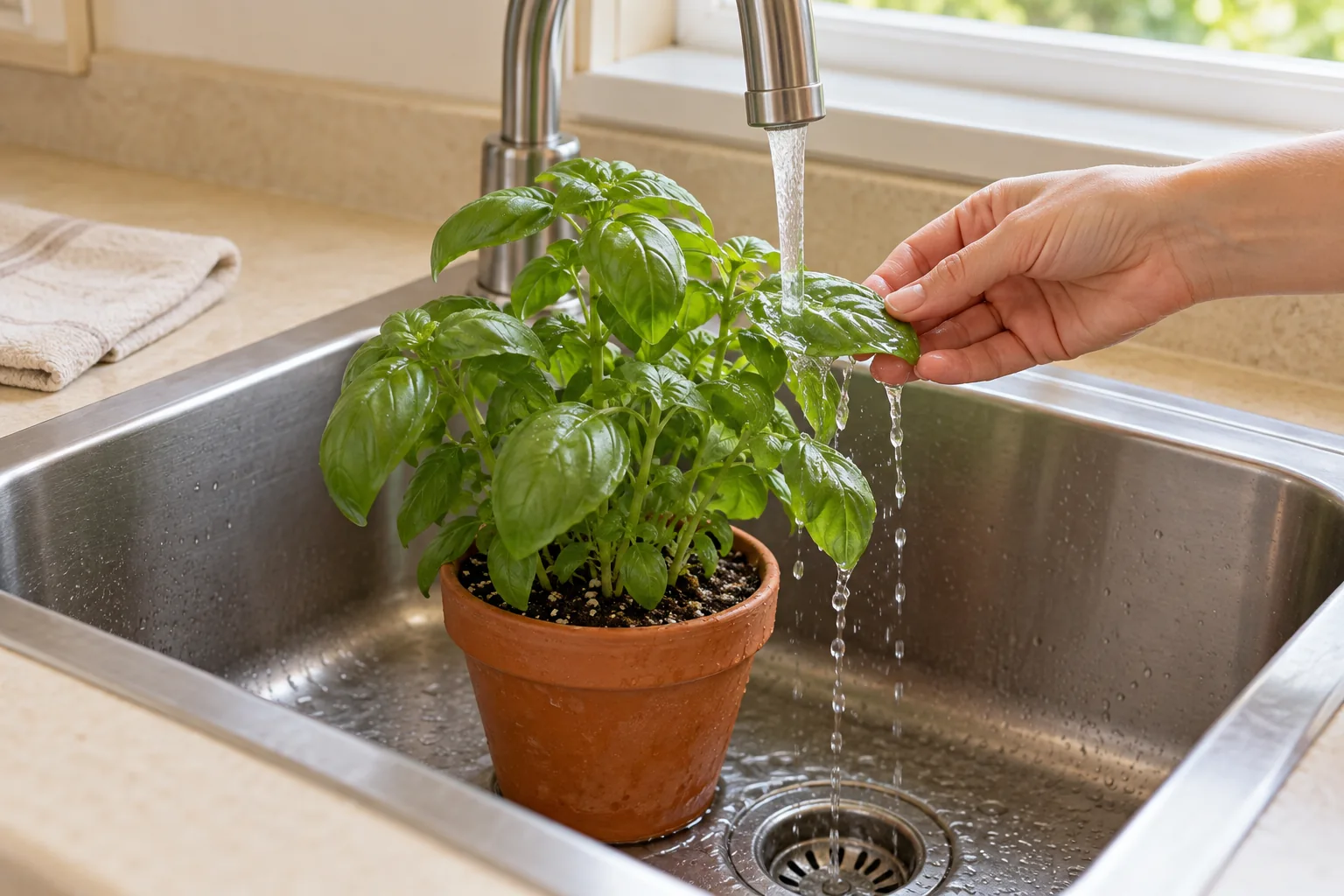
For a small pot, consider a plain-water rinse at a suitable indoor tap if there is enough room. Check the whole route first: the doorway, the height beneath the faucet, and where you will set the wet container afterward. Keep the plant away from indoor pots during the work. If the canopy is too wide to turn without snapping stems, the sink hasn’t solved the access problem.
For a large pot or a plant attached to supports, work outside where it stands. Bring a little plain water and a container or tray for the work. Make room to see the backs of leaves from the balcony floor; don’t lean over the railing to reach a colony. If another pot blocks you, move it out of the way rather than drag the infested plant and its trellis across the balcony.
Plan where water will land before rinsing. Keep it off a neighbor’s balcony, protect the walking surface from spills, and leave the building’s drainage clear. For routine water access and accessible saucers, see how to water balcony plants without an outdoor tap.
A shower may work for a manageable pot if you have room to wash it with plain water and clean up afterward. An Iowa State Extension answer about aphids on a hibiscus suggests washing them off with a stream of water in a shower or tub. Consider it for a plant you can handle; you don’t need to haul every infested pot indoors. It offers little advantage if you cannot turn the plant or reach its leaf undersides. Keep pesticide application separate: a bathroom isn’t a suitable location simply because it has a drain. EPA advises against using outdoor pesticides indoors.
Use insecticidal soap only when it fits the job
If aphids are damaging growth and physical methods aren’t sufficient, a labeled insecticidal soap may be useful. It still requires access to the insects. Colorado State University Extension explains that soap must wet the pest directly; it doesn’t provide continuing protection after drying. Spraying the tops of leaves while missing colonies underneath is unlikely to solve the problem. Avoid spraying natural enemies working among the aphids; beneficial insects can also be affected.
Read the label before purchasing or applying it. A ready-to-use product avoids mixing a concentrate, but still needs the same checks. Check that it allows the plant and growing location you intend to treat, and follow its application, protective equipment and repeat-treatment instructions. For herbs and vegetables, check the edible-crop directions and any waiting period before harvest. Washing the crop later doesn’t replace those directions. EPA’s label guidance explains that labels define where, how much and how often a pesticide may be used.
Some plants are sensitive to soaps, and growing conditions can increase the risk of injury. UConn Extension cautions against treating drought-stressed plants and applying soap on hot, sunny afternoons. Follow the product’s restrictions and any small-area test directions. Use a labeled plant product rather than an improvised dish-detergent mixture; household detergents can damage foliage.
On a balcony, also check whether you can apply it without drift or runoff reaching adjacent spaces. If you cannot meet the label’s directions there, choose another method or seek advice. Follow the label for equipment cleaning and waste handling. EPA says never to pour pesticides down sinks, toilets, sewers or street drains; ask your local waste authority about leftover material that cannot be used as directed.
Recheck before repeating or escalating
After removing aphids or treating the plant, look at the same shoots and leaf undersides again. Check for living aphids and watch how new growth develops. Maryland Extension notes that feeding damage to expanding leaves can be permanent, so their curled appearance alone isn’t a reason to repeat treatment.
If aphids remain, look for what you missed. Are they tucked into curled leaves? Could you reach the back of the plant? Did plain water dislodge them, or merely wet them? Insecticidal soap affects aphids it contacts during application, and follow-up checks may show a need for another treatment. Any pesticide repeat must stay within its label directions. Spraying more often won’t help if you still can’t reach the insects.
Also look for ants tending the colony and for natural enemies already at work. UC IPM explains that ants protect aphids from predators, and recommends regular monitoring during rapid plant growth. Note what you see rather than assuming every returning colony has the same cause.
If the plant continues to decline or the diagnosis remains uncertain, take photographs of the insects and the whole plant for Extension advice. Include what you applied and when.
Begin with one affected pot and an action you can carry out carefully. Check whether it helps before deciding what to do next. You can protect the plant without spraying the entire collection whenever an aphid appears.