
A balcony garden can be easy to start and tiring to water. The tap is in the kitchen or bathroom. The plants are through a door and across the balcony. As the collection grows, one watering round can mean several trips with a full can, followed by saucers to empty.
Before buying a larger can or a watering system, walk the route you already have. Find out what you can carry comfortably, how your pots behave in that spot, and whether you can reach them all without rearranging the balcony. Those answers may let you simplify the garden. If carrying water is still the sticking point, you can choose equipment for that particular job.
Trace the trip from tap to plants
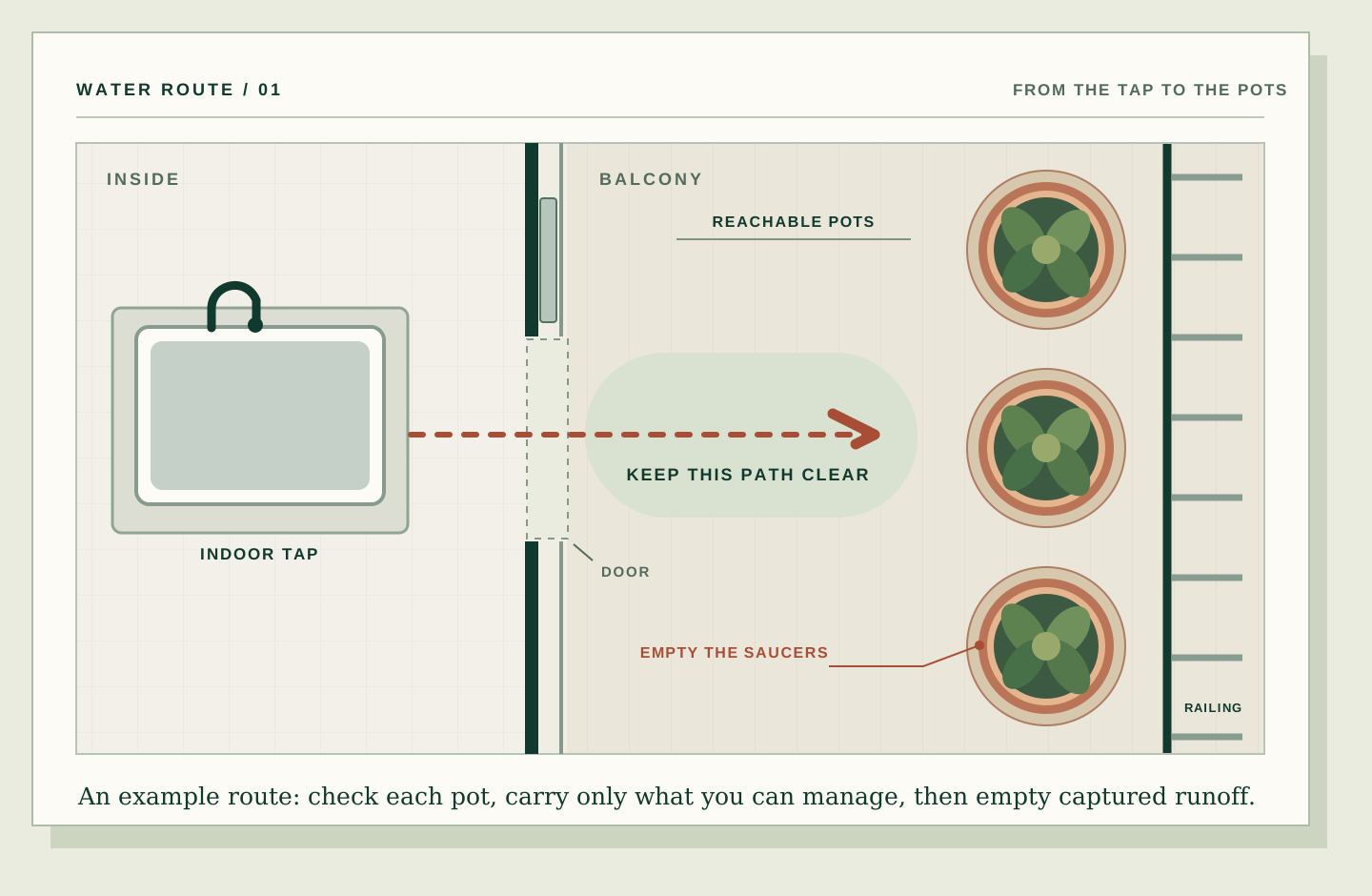
Fill a can at the nearest usable tap with an amount you can carry and pour steadily. Walk to the balcony as though you were about to water. Where will you put the can while you open the door? Do you have to step around a rug or chair? A bigger can saves trips only if its filled weight is manageable on that route.
From the doorway, look at each pot. You need to reach the mix to check it, pour into the pot, and get to its saucer afterward. If you have to lean over the railing or move other pots out of the way, change the arrangement. A pot takes up more working space than its base suggests.
If you are still planning the garden, mark this path before assigning every spare corner to a plant. Keep containers where you can tend them from the balcony floor, and check your building’s rules for anything placed near railings or drainage points.
Learn what a real watering round asks of you
A calendar cannot tell you when every balcony pot needs water. Container size, growing mix, plant, sun, wind, and weather all change how quickly the mix dries. The University of Maryland Extension recommends feeling below the surface before deciding to water. The top can look dry while the mix underneath is moist. Wilting is not proof of dryness either.
While you are learning the pots, check them daily, especially in summer. That means checking, not watering each one every day. Feel the mix below the surface. If a pot is light enough to lift comfortably, compare how it feels just after watering and as it dries. For a standard pot with drainage holes, water the mix at the base when it needs it, until the whole mix is moist and excess drains out. If water rushes down the sides of a very dry pot, water again and check whether the mix has absorbed it. Maryland Extension explains these checks and the dry-mix problem in its container-growing guidance.
For an ordinary week, keep a short note. Repeat the exercise when the weather is hotter or windier:
| Note | What you are looking for |
|---|---|
| Pot and position | Which containers needed water, and which were still moist? |
| The trip | How many comfortable can refills did the full round take? |
| Runoff | Which saucers or trays needed emptying afterward? |
| The routine | Could you repeat this on a busy day? |
Leave pots that are still moist alone. Use your notes to judge whether the refills and saucer-emptying fit your week. If watering the plants you own already takes more time or effort than you can usually give it, wait before adding another.
Make the setup easier before expanding it
Pots scattered across every open patch are harder to check. Bring them closer to a clear path where the light still suits them. Group plants with similar watering needs, leaving room to see the mix, pour, and remove a saucer. Maryland Extension recommends grouping containers with similar care needs for convenience. A neater row is no improvement if it puts a sun-loving plant in shade or crowds the door.
Many tiny pots also mean many separate checks, and small containers can dry quickly in exposed conditions. A single huge planter brings its own problem: filled with wet mix, it may be difficult to move. Plants that share it also need compatible care. Often the simpler change is to keep fewer pots and make sure each one is easy to tend.
Before buying another plant, picture its place in the watering round. Can you reach it with the same can? Will it add a refill or an awkward spot to check? Empty floor space does not always mean useful growing space.
Give excess water somewhere to go
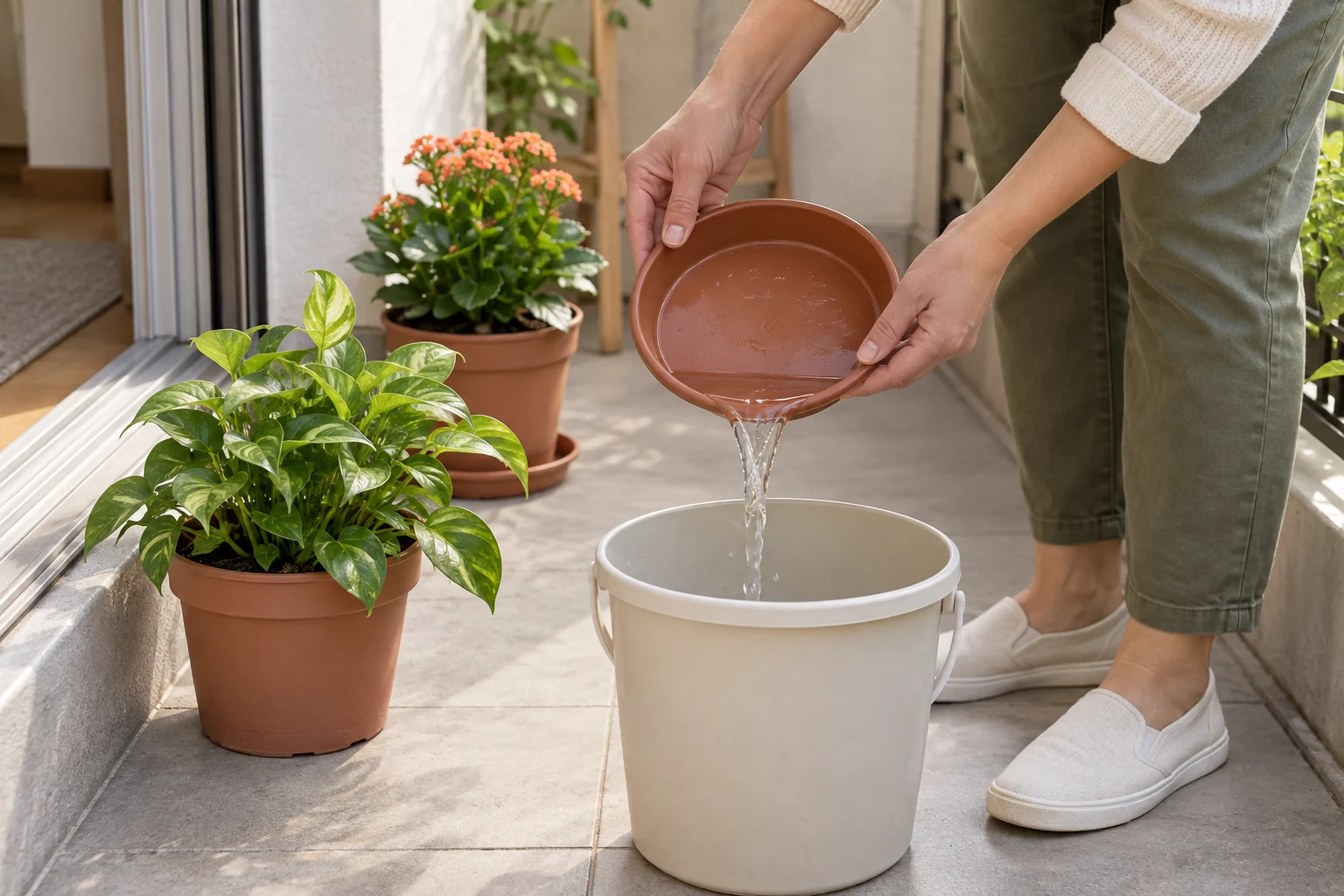
A standard container needs a way for excess water to drain without leaving roots in waterlogged mix. On a balcony, you also need to catch that water before it reaches the floor or a neighbor below. Maryland Extension recommends drainage holes and, where runoff must be contained, saucers that you empty regularly. University of Illinois Extension notes that detachable saucers are easier to empty and that plants should not stand in the collected water.
Choose a tray you can reach and empty after watering. Think about rain as well as the water you carry outside; a tray that works on a dry day may fill in a storm. Keep the balcony’s own drainage clear and check building rules before changing anything that affects the floor, railings, or a neighbor’s space. If you are unsure whether a large filled planter is suitable for the structure, ask building management. There is no safe load figure to guess from an article.
Count emptying the trays as part of watering. If reaching them is harder than filling the can, rearrange the pots before shopping for another device.
Choose a method for the problem you still have
The notes you made earlier should point to a specific problem. Use that problem to choose a method:
| Method | When it can help | Work that remains |
|---|---|---|
| A can you can carry comfortably | The collection is small and the route is clear. | Check each pot, make the necessary trips, and empty runoff. |
| A container with its own water reservoir | One suitable plant or group of plants needs more time between refills. | Refill the reservoir, check the growing mix and plant, and follow the container’s overflow instructions. |
| A hose or irrigation arrangement approved for your home | The repeated indoor-to-balcony carrying is the main obstacle and the tap, route, and building rules allow it. | Check connections, confirm water reaches the pots as intended, watch runoff, and keep checking the plants. |
A reservoir still needs refilling and observation. Maryland Extension describes self-watering containers with a reservoir and an overflow opening; check how the particular container you choose handles both. A hose can spare you carrying trips, but you will still need to check pot moisture and runoff. Before using a tap-connected setup, check its fittings and instructions and confirm it is allowed in your home. Once it is in use, watch for leaks and keep checking the plants.
Try naming the problem plainly: “I can reach every pot, but carrying water takes too many trips,” or “The trips are fine, but I cannot empty the trays easily.” Changing how water travels may help with the first. For the second, change the containers or their placement. A larger can can make an awkward route heavier.
Keep the garden within a routine you can repeat
If watering still takes more time or effort than you can give it, change the size of the garden. Move a hard-to-reach pot, let go of one whose needs do not suit the balcony, or keep fewer plants. Choose replacements for the light, wind, and care you can actually provide. Watch how each container behaves in your space, whatever the label says.
Add another pot only when the current group is easy enough to check, water, and drain in an ordinary week. This is a more useful limit than the number of pots you could physically fit.
If a sketch would help, mark the tap, door, path, and pots in the Garden in Place planner. What you are aiming for is a garden you can reach, water when it needs it, and leave drained without sending water below.