
In this guide
Your balcony cucumber has yellow flowers, but you rarely see a bee. Perhaps you’ve been moving pollen with a brush and now cannot find a male flower. Before adding another plant or making pollination a daily chore, check what the variety needs.
Many cucumbers need pollen carried between separate male and female flowers. Others, called parthenocarpic varieties, can produce fruit without pollination. An all-female plant is not automatically one of those varieties. Johnny’s Selected Seeds explains these different flowering and fruiting traits.
Whether you can help depends on the variety, the flowers available and the space you have.
Check the variety’s pollination needs
Find the seed packet, nursery label or order confirmation, then look up the exact variety on the breeder’s or supplier’s website. A general description such as “patio cucumber” tells you too little to choose a pollination method.
Three terms can appear in those descriptions:
| Term | What it describes | What you need to establish |
|---|---|---|
| Monoecious | Male and female flowers on the same plant | Check whether the variety needs pollination; flowering habit alone does not settle it. |
| Gynoecious | Mostly or entirely female flowers | Check separately whether the variety needs pollination. |
| Parthenocarpic | Ability to form fruit without pollination | Routine hand-pollination is unnecessary. |
These terms describe different traits. A variety can be both gynoecious and parthenocarpic. Johnny’s also explains that seed for a pollination-dependent gynoecious variety may be blended with seed of a pollen-producing variety. If you kept just one seedling from that mixture, the packet alone cannot tell you which kind is in your balcony pot.
If the description says only “all-female” or “self-pollinating,” ask the supplier whether that exact variety forms fruit without pollen transfer. Keep the answer with your plant notes. If you’ve lost the label, a photograph may help a nursery recognize the plant, but flower appearance alone cannot settle its cultivar or pollination requirements.
Look at the flowers without assuming fruit has set
Look behind the petals. A female cucumber flower has a small ovary resembling a miniature cucumber between the bloom and the vine. A male flower sits on a slender stalk without that swelling. University of Minnesota Extension describes these features and identifies the ovary as the unfertilized fruit.
That little cucumber is there before pollination. It doesn’t prove that pollen arrived or tell you whether the variety needs pollen. Watch whether it continues developing before counting it toward your harvest.
On many ordinary cucumber varieties, the first flowers are male and female flowers appear later. Minnesota Extension notes that these early male blossoms can drop normally. If you’ve confirmed that yours is an all-female variety, though, you may have no male flowers to find.
Choose a few flowers you can see from the balcony floor. A photograph lets you compare their development without repeatedly handling them. Leave the stems attached while you are identifying what is there.
Male flower
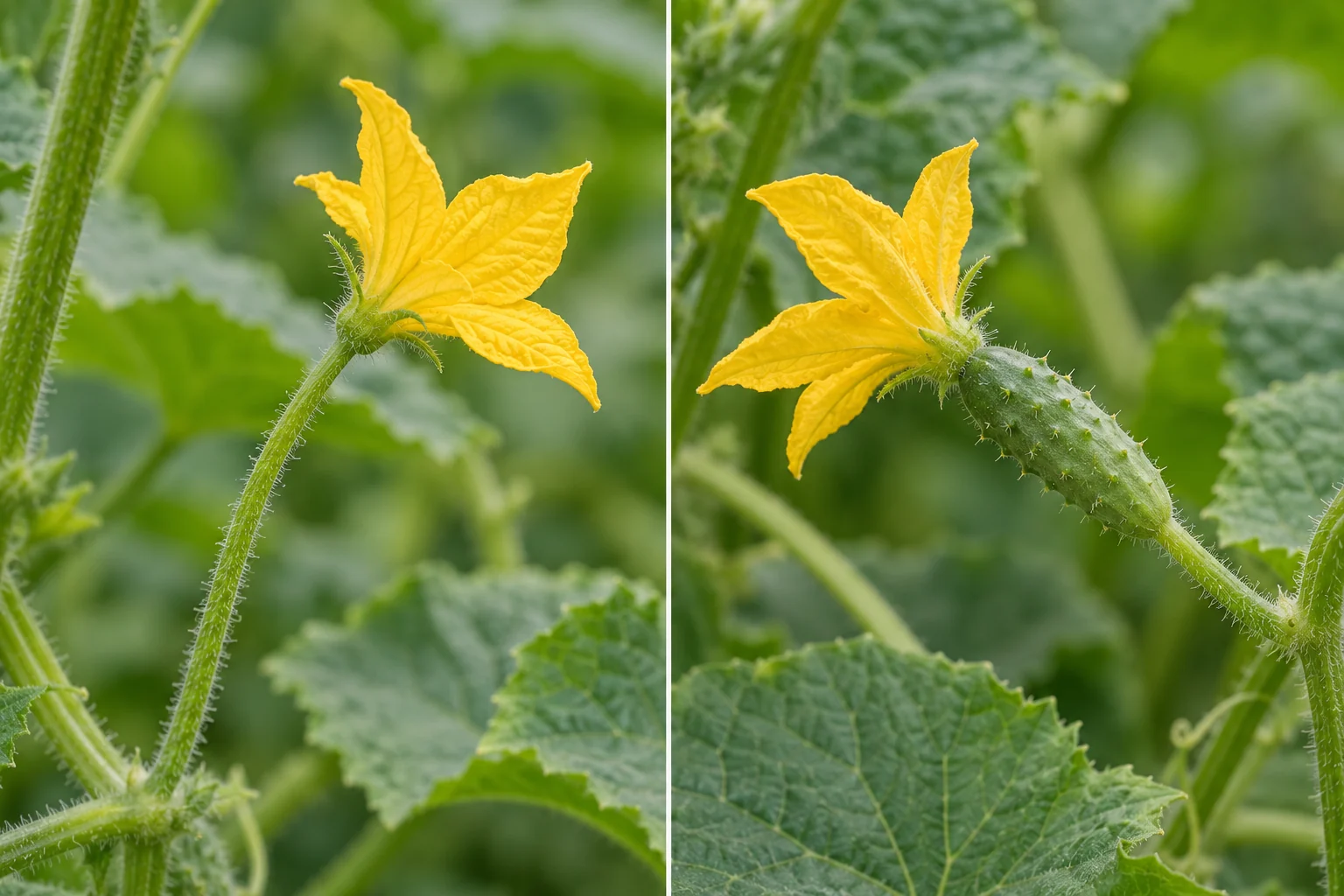
Female flower
Decide whether help is needed and possible
If reliable cultivar information confirms parthenocarpy, leave hand-pollination out of the routine. Continue caring for the plant and observing its fruit. Iowa State Extension explains that these varieties form fruit without pollination, and that pollen from standard cucumber varieties can result in seed development. There is no reason to bring over pollen simply because another vine has spare male flowers.
For a variety that needs pollination, consider both the pollen source and how pollen can reach the female flower. One plant bearing both kinds of flowers can provide its own pollen source; a second pot is not automatically required. A plant producing only female flowers may need a separate pollen-producing cucumber, depending on the variety.
Check whether insects can reach the flowers. Is the vine behind closed glass or screening? An open balcony and an enclosed sunroom offer different access. The floor number alone cannot tell you whether pollinators visit, and a brief look outside won’t reveal all the insect activity.
Minnesota Extension notes that row covers exclude pollinating insects as well as pests. A balcony screen is not the same growing environment as a covered garden row, but the advice gives you a reason to check physical barriers.
If pollen is required but no suitable male flower is available, a brush cannot supply the missing pollen. Check the variety information before buying another plant. Another vine will need its own space on the balcony, with a suitable container, support, light and room for you to reach it for care.
If you still cannot identify the plant, ask the original seller, recover an order record, or take any label details and photographs to your local Extension service. Avoid choosing a second plant on the strength of a guess.
Hand-pollinate only when it serves the plant
You can hand-pollinate when you’ve established that pollen transfer is needed and have suitable open male and female flowers available. You do not need a specialized kit.
University of Alaska Fairbanks Extension’s greenhouse guide describes two ways to transfer cucumber pollen: use an exposed male flower or a small, soft-bristled brush. Its greenhouse setting explains why assistance may be needed; it does not mean every outdoor plant requires it.
For the flower method, remove a male flower and gently peel back its petals to expose the pollen-bearing anthers. Touch those to the stigma in the center of an open female flower. With a brush, collect pollen from the male flower’s anthers and gently transfer it to the female flower’s stigma. Leave the female flower and its ovary attached to the vine.
Work where you can see the flower centers and hold your hand steadily. If the flowers are outside the railing or behind a dense tangle you cannot reach, do not lean out or pull the vine toward you. You need to be able to reach the flowers comfortably before trying this method.
Only work on the appropriate flowers when the plant needs assistance. Brushing every bloom ignores both the flowers’ different roles and the variety’s requirements.
Watch how the fruit develops
Compare the young fruit over the following days. Watch whether it keeps enlarging rather than whether faded petals remain attached. Note which flowers you assisted and what happened. These are observations, not a controlled test establishing what caused success or failure.
If fruit still fails to develop, do not assume you need a bigger brush, more pollen or another plant. Iowa State lists poor pollination and flowering too early in the season among reasons for low fruit set. A single unsuccessful flower cannot establish the cause for the whole plant.
Keep the rest of the care manageable while you investigate. Record whether the pot has become unusually dry or stayed wet, and whether the plant’s light or exposure changed. Our guides to measuring balcony sunlight and watering without an outdoor tap can help you assess those conditions without changing several things at once.
Use what you’ve found to decide what to do with the next open flower. Leave a confirmed parthenocarpic variety out of your hand-pollination routine. If pollen transfer is needed and suitable flowers are available, you can help. If the variety’s requirements are still unknown, resolve that question before giving another pot a place on the balcony.