
In this guide
The usual advice is to bury the pots in a garden or move them to an unheated garage. Neither helps much when your garden is a balcony and the largest planter barely fits through the door.
Some perennials can survive winter in pots outside. Whether yours have a reasonable chance depends on their hardiness, the exposure of their roots and the care you can give them through winter. Wrapping may help, but it cannot make every plant suitable for every balcony.
Before buying insulation, identify the plants you want to keep and work out where they could spend winter. Pots standing beside each other may need different plans.
Start with the plant, not the wrapping
A perennial can live for more than two years. That description does not tell you whether it can survive your winter, especially in a container.
Find the plant’s species and, where relevant, cultivar name. Check its hardiness against your location using the USDA Plant Hardiness Zone Map. The map describes average annual extreme minimum winter temperatures. It does not measure the temperature inside your pot or predict every cold spell.
Roots in containers have less surrounding soil to protect them. Illinois Extension explains that many plants’ roots are less cold-hardy than their above-ground growth. A plant that survives in a garden bed may therefore struggle with the same weather in a pot.
Illinois recommends choosing perennials hardy to two zones colder than your own when planning outdoor container overwintering. Use that as an initial screen, rather than a guarantee. It cannot account for every combination of plant, container and exposure.
Check the plant’s winter needs too. A dormant deciduous perennial and a plant keeping its foliage should not automatically receive the same storage or covering. Before enclosing a plant that retains foliage, ask about winter light as well as temperature. If the label is missing, start with identification. Send photographs and your location to a local Extension office, explaining that the plant must overwinter in an elevated container. Another layer of wrapping cannot answer that question.
Check the winter space your pots can actually use
Look at the balcony with the protection in place, not just the bare pots. A cluster surrounded by insulation may occupy the corner where you normally stand to water. A box that fits the containers may prevent the door from opening fully.
For each possible location, check:
- Is the pot sheltered from prevailing winds, or beside an open railing?
- Can you move the filled pot safely through the doorway and along any stairs?
- Can you reach the potting mix and drainage area without dismantling everything?
- Is the container suitable for winter outdoors, and can water leave it freely?
Larger containers can offer more protection to roots. Before increasing pot size, allow for the extra footprint and check whether you can move the filled pot. In advice reproduced by Illinois Extension, nursery writer Paul Pilon favors larger pots and sheltered grouping. He also notes the greater protection available at ground level compared with a deck. A balcony floor does not provide the surrounding soil of a garden bed.
If someone offers you a garage or enclosed porch, check the conditions before accepting. Iowa State Extension recommends a consistently cool storage environment for the dormant plants covered by its guidance. It gives 20–45°F as a storage range and warns that unheated structures can swing outside it. That range is guidance for that storage method, not a universal tolerance for every perennial.
Check a proposed storage spot’s highs and lows rather than judging it during one daytime visit. A minimum/maximum thermometer retains both readings. Thermometer World’s digital model has a Fahrenheit display and reset controls for this check. Its listed measurement range starts at 14°F, and outdoor use requires cover. Skip this model if the spot could get colder or you cannot keep it under cover. Note the readings before resetting. They describe the air at the thermometer, not the temperature of the potting mix around the roots.
Many temperate perennials need cold dormancy. A heated living room is therefore not an automatic substitute for suitable winter storage. The plant’s requirements still have to match the destination.
Decide which plants have a workable winter option
Choose a route before choosing materials. The same balcony may offer a reasonable outdoor attempt for one plant and no satisfactory winter destination for another.
| What you have established | A reasonable next step | What remains to check |
|---|---|---|
| An identified, very hardy plant and usable shelter for its pot | Consider protected outdoor overwintering | Plant-specific guidance, container condition, drainage and care access |
| A plant needing more protection than the balcony can reasonably provide | Arrange a suitable alternative destination | Actual conditions there and a manageable way to move the pot |
| An unidentified plant or an uncertain hardiness margin | Seek identification and local container advice before committing | Whether outdoor protection is sufficient for this plant and climate |
| No suitable destination and no supported outdoor plan | Accept the risk of an outdoor attempt, or choose not to retain it | Whether you are willing to lose the plant rather than keep adding materials |
For an illustrative comparison, take a zone 7 gardener with a manageable pot of chives and an accessible sheltered corner. NC State’s Plant Toolbox lists common chives, Allium schoenoprasum, for zones 4a–8b. That is a substantial in-ground hardiness margin and a reason to investigate an outdoor plan. It still does not prove that a small pot will survive that balcony’s winter.
A heavy planter holding a perennial hardy only to the gardener’s own zone presents a harder choice. Suppose there is no burial space, reachable cool storage or sheltered corner. Its hardiness margin and available protection are much weaker. The pot’s size does not settle the decision, and an insulated box is not evidence that the plant will survive. Plant-specific advice or a different destination would help more than a thicker wrap.
If keeping a particular plant matters greatly to you, make that alternative arrangement early. Ask whether a friend has a suitable garden or storage location, and confirm the transport plan. If no option fits, it is reasonable to treat that planting as seasonal and choose a better-suited perennial next time.
Protect the pots you have chosen to leave outside
Start with the sheltered location you can use, then work out how to protect the containers without blocking drainage or routine checks.
NC State Extension’s container-growing handbook describes insulating outdoor pots with materials such as bubble wrap or frost blankets. It also warns that unglazed ceramic pots can absorb water and crack when it freezes. Check the container’s suitability as well as the plant’s; wrapping should not be assumed to make a fragile pot winterproof.
For a small balcony, wrapping individual pots may occupy less space than building a large enclosure. Keep drainage openings clear and leave a way to inspect the mix. If you use a larger outer container, make sure it will not collect water around the planted pot. Allow for that extra footprint before you bring it home.
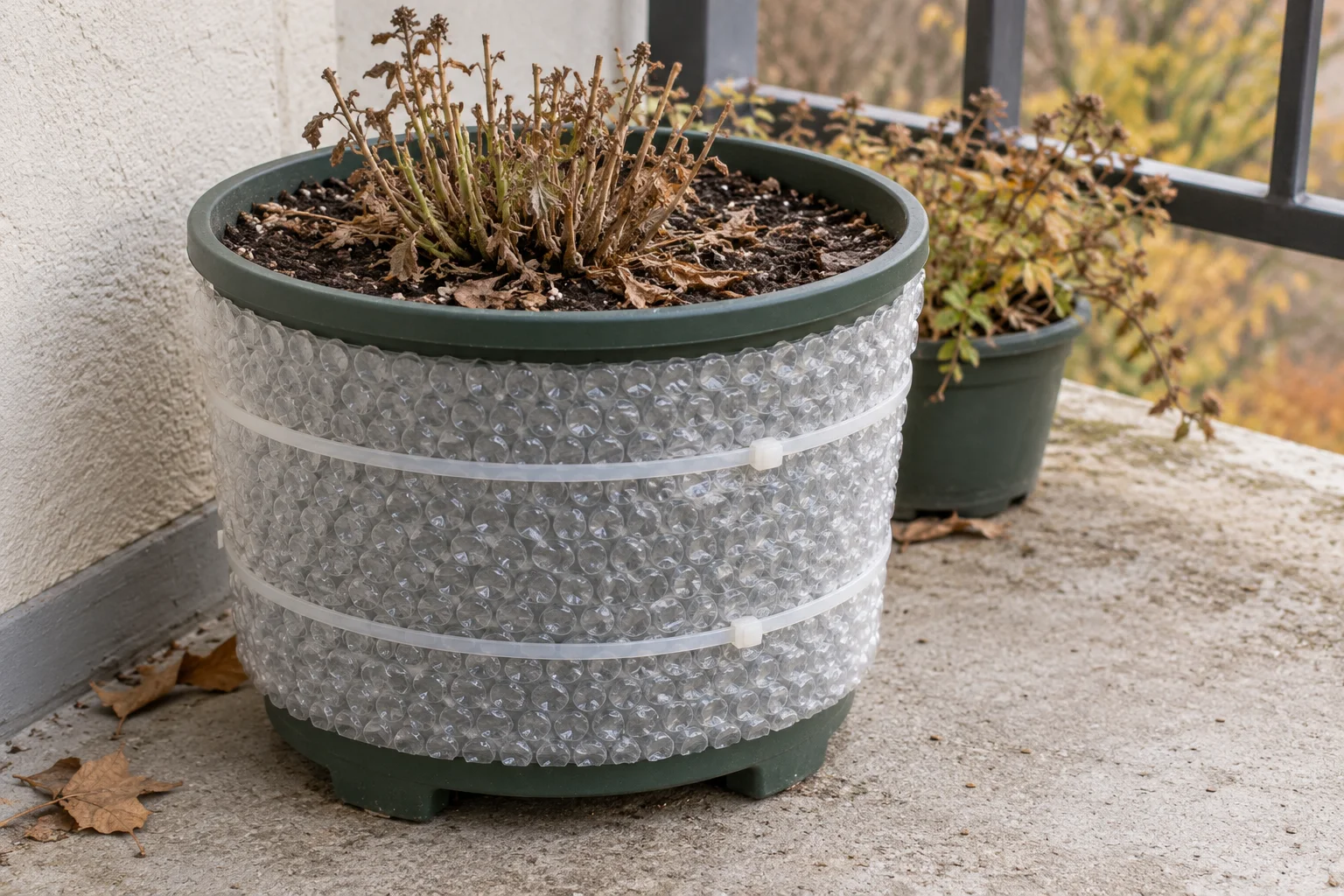
Insulation slows heat transfer; it does not generate heat. An unheated box can still become very cold during prolonged freezing weather. A wall may shelter the pots from wind, but proximity to the building alone does not establish how warm the roots will remain.
An archived UMass Extension article on containerized perennials explains that an unprotected root ball can approach ambient air temperature. It discusses commercial growing systems, so its methods are not balcony instructions. Protection still has to suit the expected conditions and plants. A ground-based nursery covering or a heated enclosure is not equivalent to a passive box on an elevated balcony.
Avoid deciding the plan by a promised number of degrees gained from a wrap. Without evidence for your arrangement, that number does not establish what your plants can tolerate.
Keep winter care within reach
Leaving pots outside does not remove the need to check them. Arrange protection so you can inspect moisture and drainage during suitable weather, including pots at the back of a cluster.
University of Maryland Extension’s winter-watering advice recommends watering as needed when soil is thawed; frozen soil does not readily absorb water. It also identifies outdoor containers as particularly vulnerable to drying and temperature changes. Check the mix rather than watering every pot on a fixed winter schedule.
During a thaw, check whether the mix is dry and the pot can drain before watering. Do not keep pouring water onto frozen mix or into a container with blocked drainage. A pot tucked beneath an overhang may miss rainfall even while the rest of the balcony looks wet. If you carry water from indoors, our guide to watering balcony plants without an outdoor tap covers that trip.
Recheck the arrangement after wind, snow or a thaw. Has protection shifted? Can you still reach the pots? Is water accumulating where it should drain? These are useful maintenance observations, though they cannot certify that every plant has survived.
A thermometer can help you understand conditions at the place you measure. It does not supply the plant’s root hardiness limit, and an air reading inside a cover is not a root-temperature reading. If the setup becomes much colder than expected, seek plant-specific advice before assuming extra insulation will be enough.
Start with one plant and one realistic winter location. If that location cannot provide the conditions the plant needs, arrange another destination or change what you grow there next season. If you choose not to keep a planting, our guide to old potting soil on a small balcony can help with the material left behind.