
In this guide
The pots need watering again, and you’re considering mulch. Straw looks easy to carry upstairs, but it may end up across the balcony. Pebbles look more likely to stay put, but they add weight and another layer to move when you want to check the potting mix.
Mulch can be worth trying if you want to cover exposed mix and have room for it. On a windy balcony, choose something you can keep in the pot, water through, and remove without much trouble. Leave the surface bare if a covering makes those everyday jobs harder. A layer on top won’t necessarily solve a plant’s rapid water use.
What would mulch do for this pot?
Decide what you want the cover to do. You might want to keep exposed potting mix from scattering onto the floor or cover the surface between established plants. Hoping to water a thirsty tomato less often is a different expectation.
Water leaves a planted container both by evaporation from the growing medium and through the plant’s leaves, a process called transpiration. Wind can increase leaf water loss. Covering the mix does not shield the leaves from that exposure. Virginia Cooperative Extension explains these separate losses and why plant size, weather and growing conditions affect water demand.
A pine-bark study found reduced evaporation from covered growing medium under controlled conditions, but the experiment had no plants. UC Davis’s container-mulching guidance, focused on nursery weed control, reports no decrease in evapotranspiration from container mulch. These different settings and outcomes do not establish that every cover is ineffective, or give you a reliable new watering interval for your balcony.
Watch whether the cover makes watering easier in your own pot. If the plant already needs more water than you can regularly supply, a topping should not be your whole plan. You may need to reconsider the container or its position.
Check whether the pot has room for a cover
Look at the gap between the potting mix and the rim. That space lets you pour water without immediately spilling over the edge. Mulch would occupy some of it. University of Maryland Extension recommends leaving room below the rim when filling a vegetable container, and allowing seedlings to establish before mulching.
For an existing pot, work with the space available. Don’t scoop out rooted mix just to fit a layer copied from a garden-bed recommendation. If the pot is already full, leave it uncovered until a suitable time to repot.
You also need a clear patch around the plant’s base and a way to reach the mix. Keep the cover away from stems rather than building a mound against them. The Royal Horticultural Society advises against smothering low-growing plants or piling mulch against woody stems. Its general advice supports keeping the plant clear, rather than squeezing a cover into every available gap.
Before adding anything, imagine checking the far side of the pot and emptying its saucer. Can you do both comfortably? A covering that requires you to move a heavy planter or lean into an awkward corner is a poor fit for that arrangement.
Compare loose mulch, mineral toppings and a bare surface
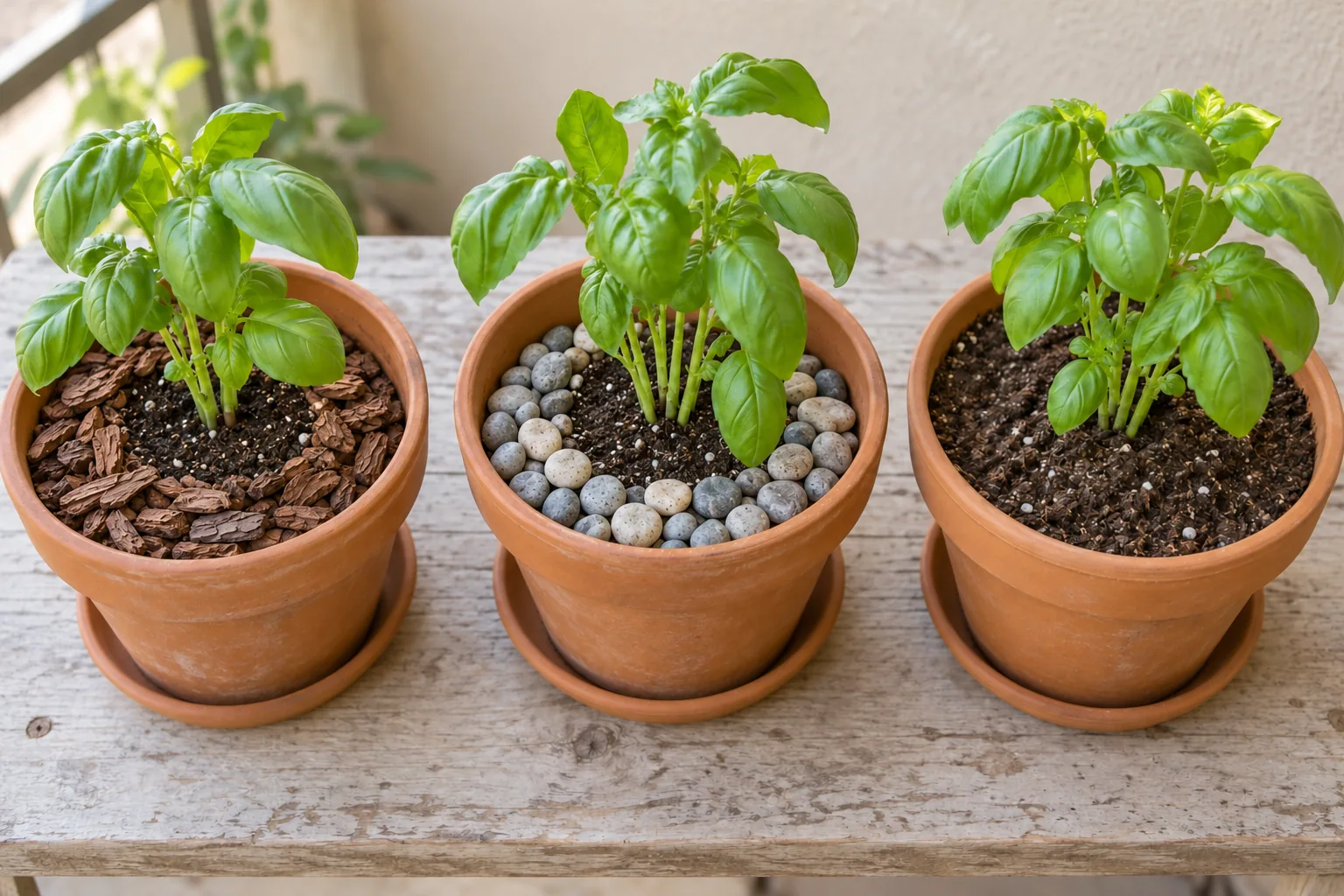
For an established vegetable container with spare headroom, bark is a reasonable first material to consider. Maryland Extension includes pine bark among its container-mulch options. Colorado State’s landscape guidance describes bark as less prone to blowing away than straw, while acknowledging differences in texture. That is a useful starting point, not proof that a particular bag will stay on an exposed upper-floor balcony.
Consider the material you can obtain and manage. “Organic mulch” can mean fine shreds, broad chips or loose straw; they won’t behave identically. Mineral toppings vary too. Pebbles and gravel require different handling from a handful of bark.
| Surface choice | Why consider it? | What to check on your balcony |
|---|---|---|
| Bark | A loose cover you can move aside to reach the mix | Whether its pieces remain in place when dry, and how easily you can remove them |
| Straw or shredded leaves | An organic material you may already have | Scattering and cleanup; straw and dry leaves can blow around |
| Gravel or pebbles | More resistant to wind movement than lightweight organic material | Added weight, access beneath the topping, and removal at repotting |
| Bare potting mix | No extra layer to buy, handle or separate | Whether exposed mix is creating an actual problem that needs another solution |
The wind comparison comes from Colorado State Extension. Its application depths are for home landscapes; don’t transfer them wholesale to a small pot.
Before choosing stone, think about where you’ll put it when you empty or replant the container. Don’t add stones simply to pin down another material that keeps escaping. If handling the pot is already a chore, a lasting topping may make the next job harder.
Try one accessible pot before covering them all
Start with an established plant in a reachable container. Choose one that has enough headroom for the material’s suitable application guidance while retaining room to water. There is no single depth that fits every material, plant and pot; skip the cover if you cannot accommodate it sensibly.
Check the growing medium first and water if the plant needs it. Place the cover on the surface, keeping the base of the plant clear. Leave an accessible place where you can move it aside for later checks.
Watch what happens during ordinary care and after breezy weather, especially once the material dries. Check for scattering and whether watering washes it over the rim. You should also be able to reach the mix without digging through the cover. Use those observations to decide whether it suits this pot.
A wet layer sitting neatly just after application doesn’t tell you whether it will stay put. Let it encounter the conditions you’re trying to manage. If it repeatedly escapes, remove it or reconsider the material before covering every pot and taking on a new cleanup routine.
You can note when the pot needs water, but changing weather and plant growth make before-and-after comparisons uncertain. Don’t extend watering intervals merely because the pot is now mulched.
Keep checking the pot beneath the cover
Move the topping aside and feel the growing medium below the surface. Check according to the plant’s needs; the appearance of dry bark or damp stones won’t tell you whether its roots need water. Maryland Extension’s container-care guidance also cautions that wilting alone cannot distinguish a dry pot from one kept too wet.
Keep the watering and runoff jobs accessible. Our guide to watering balcony plants without an outdoor tap explains how to build a routine around reaching pots, checking the mix and managing saucers.
If rapid drying continues, revisit the plant and container. Maryland Extension identifies small containers, exposed positions and larger established plants as factors in faster drying. A more sheltered position may help, provided it still supplies suitable light. More mulch is not automatically the next step.
Keep the cover if it does the job you chose it for and you can still tend the pot easily. If it scatters across the balcony, crowds the rim or makes caring for this plant harder, leave the surface bare.