
In this guide
You start watering a balcony planter and ants hurry out of the mix. The plant looks much as it did yesterday, but now you’re wondering whether to empty the pot, soak it or put something in the soil. If it holds strawberries or herbs, choosing a treatment feels less straightforward.
Ants in potted plants don’t automatically mean the planting needs rescuing. First check what the ants are doing and whether there is a problem beyond their presence. A healthy pot may be worth leaving alone. Damaged plants, ants tending other pests or activity that interferes with using the balcony call for a closer look.
Decide what this pot needs before disturbing its roots or buying an ant treatment.
Check where the ants are going
Watch the route before moving the container. Ants may cross the outside, disappear beneath it or repeatedly enter the growing mix. Others climb the stems and gather on leaves. From the balcony floor, follow the trail beyond the pot as far as you can see. A trail across a container doesn’t establish that the nest is inside it.
Look at accessible shoot tips and leaf undersides. Aphids, soft scales and mealybugs produce sugary honeydew that attracts ants; ants can also protect these insects from natural enemies. UC IPM’s ant guidance explains that relationship. Sticky foliage is a reason to inspect further, rather than a diagnosis by itself. If you find aphids, our guide to managing them without a hose addresses that separate problem.
Small heaps of excavated mix or ants carrying pale brood during ordinary watering can suggest nesting activity. The RHS describes soil heaps and ant brood, while noting that the pale objects people call eggs may actually be pupae. You don’t need to dig through the roots to find a queen before deciding what to do next.
Take a close photograph if you can do so without disturbing the ants, and a wider one of the pot and plant. Both will help with identification more than a description such as “tiny black ants.”
At the pot and mix
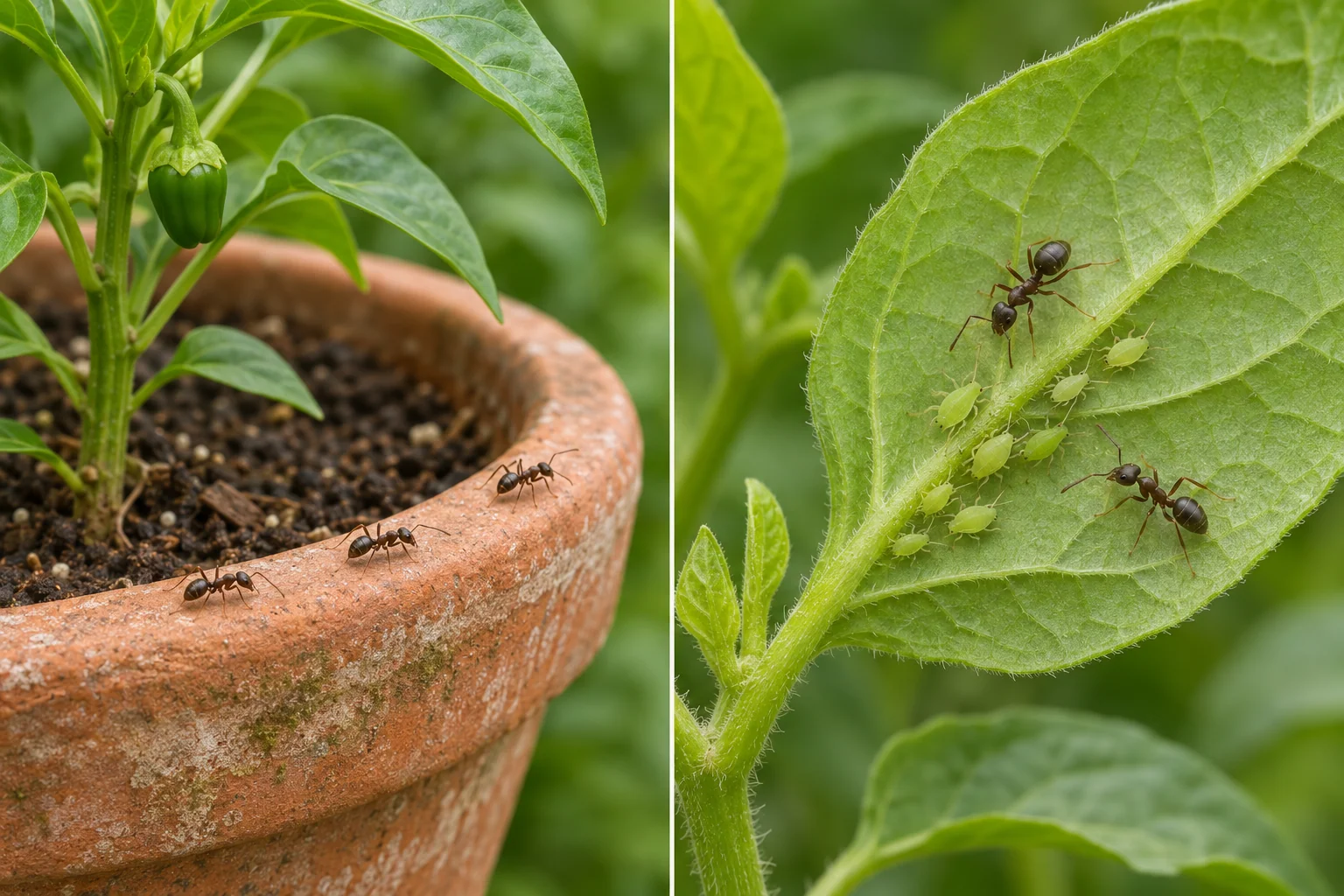
On the leaves and shoots
Decide whether this pot needs intervention
Look at the plant’s growth and the space around it. Excavated mix burying low growth is a different concern from ants reaching your seat or entering the apartment. A plant growing normally may need a different response again. Treating the potting mix won’t necessarily address each problem.
In a Maryland Extension response about ants nesting in an outdoor philodendron, the adviser explains that ants may simply be using the loose potting medium and need not be removed. That supports a leave-it-alone option for a healthy planting. It doesn’t establish that every ant species or every affected plant is harmless.
For example, imagine an established strawberry pot with normal growth. A few ants enter the mix, but you find no obvious plant injury or sap-feeding pests, and the activity isn’t interfering with the balcony. Observation is a reasonable starting point. Record what you saw and check the same plant again during routine care, rather than stripping its roots immediately.
University of Delaware Extension documents pavement ants damaging vegetable transplants on the Delmarva Peninsula, including injury at the stem base. That finding doesn’t identify the ants in your pot. It does mean visible damage deserves investigation, even when you’ve read that ants are generally harmless.
If ants sting, or you’re unsure what is damaging a plant, ask your local Extension office for identification and suitable advice before disturbing a suspected nest. A generic pot remedy isn’t a substitute for knowing which problem you’re dealing with.
Compare the options before disturbing an established plant
Match the action to what you’ve found. The options below aren’t a sequence of removal methods to work through.
| What you find | A useful next decision | What to avoid assuming |
|---|---|---|
| Healthy plant, tolerable outdoor activity | Keep observing during ordinary care | Every ant needs removing |
| Ants gathering around confirmed sap-feeding pests | Address those pests appropriately | Treating the mix will resolve the leaf problem |
| A troublesome nest in a manageable pot | Compare repotting with other suitable, verified options | Root disturbance is harmless |
| Suspected damaging or stinging ants, or an awkward large planter | Get identification and advice for that plant and location | A general household ant product belongs in the pot |
Maryland Extension’s established-container response discusses replacing mix when nesting ants are a nuisance. Repotting can disrupt the nest and the planting, so plan the whole job first. Can the plant tolerate the disturbance? Can you handle the root ball, and where will the removed material go? Have a replanting plan before tipping out a large perennial.
The Maryland philodendron response also discusses flooding as a possible way to encourage ants to leave. It warns that roots can be deprived of oxygen and gives no reliable soaking duration. Its advice cannot serve as a universal bath recipe for edible plants, succulents or large mixed planters. Repeated flooding to see whether ants still emerge changes the plant’s watering conditions too.
An ant bait may be appropriate for a problem that warrants control. UC IPM explains that workers carry slow-acting bait back to the colony and that effectiveness depends on the ant species and bait. This differs from killing visible workers with a spray. It also takes time; a line of ants at a bait is not, by itself, evidence that you should add another pesticide.
Food plants need a careful check of the permitted use. Clemson Extension’s fire-ant guidance for vegetable gardens explains why a product allowed around a garden may not be allowed within it. Those fire-ant recommendations aren’t a general treatment plan for balcony pots. Before purchasing or applying a product, read its label for the pest, location, specific crop and placement.
Make the response fit the balcony
Before repotting or moving anything, identify a working position where you can reach the plant and contain the mess. A small pot you can lift steadily presents a different job from an established planter behind a chair. Keep the route through the door and along the balcony usable.
Imagine a large edible planter where ants keep appearing near the kitchen door. You cannot manage the root ball well enough to empty it. Document the activity and ask for identification and advice suited to a planter that must stay in place. An unverified soil drench doesn’t become suitable because repotting is awkward. If the trail enters a shared wall or building gap, involve building management in that part of the problem.
Keep watering tied to the plant’s needs. Our balcony watering guide covers checking moisture and making runoff collection accessible. Any plain-water work still needs somewhere for excess water to go without reaching a neighbor below.
Pesticide handling requires its own plan. The EPA advises following label directions and keeping baits out of children’s and pets’ reach. A narrow balcony may offer few suitable placement points. If you cannot meet the directions there, seek another option rather than improvising a location among edible foliage.
Never empty leftover pesticide into a balcony drain or indoor sink. Follow the label’s disposal instructions and ask the local waste authority about material you cannot use appropriately, as explained in the EPA’s pesticide disposal guidance.
Recheck the plant and the reason for acting
Return to the concern that prompted your decision. If you chose observation, check the same plant’s growth and the places where activity was concentrated. If you addressed aphids or another identified pest, examine those shoots again. If ants were entering the apartment, watch that route as well as the pot.
Write down which container you checked, where the ants were going, what the plant looked like and what you did. Include any product’s name and application date. When you check again, you’ll have a record to compare rather than a memory of having “tried everything.” Follow any pesticide monitoring or repeat-application instructions on its label.
If the plant declines, the ants’ identity remains uncertain or suitable actions haven’t resolved the nuisance, send Extension the photographs and notes. Include the plant species, your location and whether you harvest anything from the container. Those details help distinguish an ant-management question from a plant-care problem that happens to have ants nearby.
Leave a healthy planting intact when the activity remains tolerable. If the pot has a problem, choose a response you can carry out properly in that space, then check whether it addresses the concern that prompted you to act. One container with ants doesn’t require treating the whole balcony.