
In this guide
At the nursery, a plant looks small enough to fit beside your balcony chair. As it grows at home, its leaves may reach the railing or its flower stems catch every gust. The pot may need more water than you can carry out each day. Replacing it with another plant labelled tough can leave you with the same problem.
To choose plants for a windy balcony, start with one usable growing position. Check its light and exposure, then work out whether the mature plant will fit and whether you can care for it there. Low, compact growth can help, but it does not make a plant or container windproof.
There may be room for a small herb or flowering clump where a tall specimen would be difficult to manage. Some positions are better left empty.
Choose the growing position before the plant
Look at the place where the plant’s leaves will sit, rather than calling the whole balcony windy. Existing walls or a solid balustrade may provide some shelter, while an open side remains exposed. The Royal Horticultural Society’s balcony guidance recommends taking advantage of protection already present and notes that hot, windy conditions can dry containers rapidly.
If you already have plants, watch them from a safe position during ordinary breezy weather. Notice whether the leaves move freely or repeatedly strike a wall or railing. Look for rocking at the plant’s base and check whether the container has shifted. These observations tell you what needs attention. They cannot establish a safe wind speed or explain every damaged leaf.
A pot that shifts or tips needs a different arrangement before you buy a replacement plant for it. Adding stones or choosing a heavier container does not, by itself, establish that the setup is suitable. Keep pots inside the balcony and follow the building’s restrictions; attachment or structural questions need advice specific to that building.
Check the light in that same position. A protected floor corner may receive much less sun than the railing above it. Our guide to measuring balcony sunlight explains how to observe light at foliage height. Don’t choose a sun-loving plant for the sheltered corner unless that corner actually supplies suitable sun.
Check the mature plant, not just the nursery pot
Find the botanical name and, where relevant, the cultivar name, then check the expected height and spread. That small nursery plant may eventually fill your walking space or grow beyond the protected position.
Shape matters too. A low mound keeps its foliage in a different part of the balcony from a tall canopy. The RHS identifies narrow or small leaves and low growth among useful features for exposed roof and balcony planting. These are clues when comparing plants, not proof that anything with small leaves will work.
Before putting a plant on your shortlist, ask:
- Will the mature foliage fit the intended position without rubbing against nearby surfaces or blocking access?
- Does the named plant suit the light and local growing conditions, including summer heat?
- Are you choosing a seasonal display, or expecting it to remain outdoors through winter?
A drought-tolerance description does not tell you how long a planted pot can go without water. Likewise, a perennial’s suitability for a garden bed does not settle its winter prospects in an exposed container. Use our guide to balcony perennials outside in winter for that separate decision before committing to a permanent planting.
If you ask a local nursery or Extension office for help, describe your location and the light where the plant will grow. Explain the exposure you observed and whether the pot must stay outside all year. That gives them more to work with than a request for a plant that likes wind.
Make sure the container and care fit
Choose a container for the plant’s root needs and the space where you will tend it. A narrow decorative pot is not automatically a workable home for the plant above it. NC State Extension’s container-growing handbook recommends considering both container depth and total volume and providing drainage holes.
Picture yourself caring for the mature planting. You need to reach the growing medium, pour water where it is needed and deal with drainage without moving an unwieldy pot. Leave room to open the door and use the balcony too.
Water demand changes with the plant, its growth, the container and the weather. NC State includes wind, light, temperature and the balance of roots to growing medium among the factors affecting watering. A drought-tolerant plant still needs checks appropriate to its needs; a windy day is not a reason to keep adding water to an already wet pot.
If the only tap is indoors, work through the sink-to-pot watering route before adding plants. Choose a compact plant you can care for comfortably over a larger one that needs more water than you can regularly carry.
Compare a few plants that fit those conditions
The following choices are worth considering for sunny positions with manageable exposure. They serve different purposes, and each has limits. Their profiles support suitability for exposed sites or containers; they are not results from a high-rise balcony wind trial.
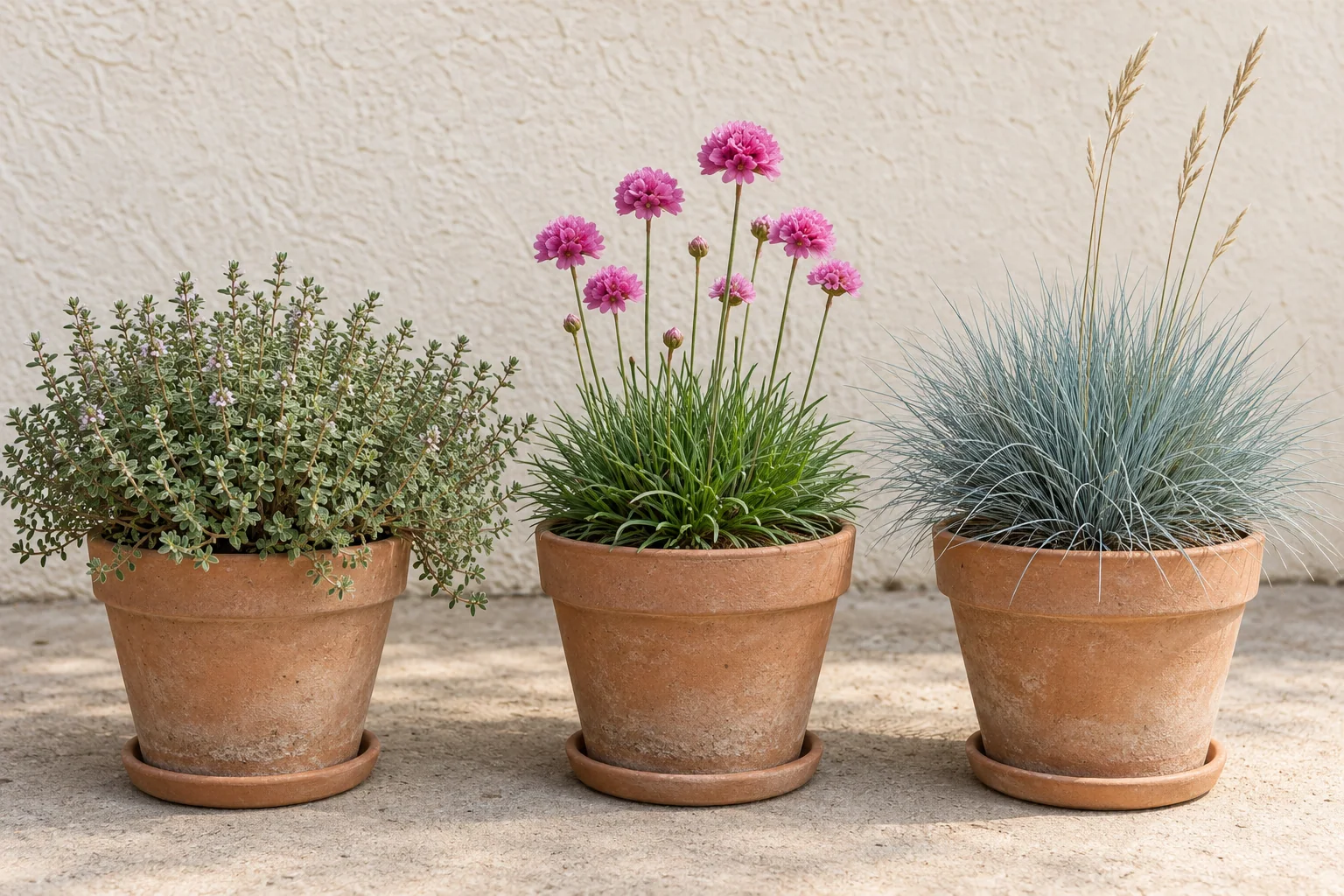
Common thyme for a small culinary planting
Common thyme, Thymus vulgaris, is a useful candidate when you want an edible herb with a low, bushy form. NC State’s plant profile describes a mound about 6–12 inches high and 6–16 inches wide, suitable for containers, with full sun and good drainage.
Compare those dimensions with the space beside your chair or doorway. Check the particular cultivar; plants sold as thyme do not all have the same habit.
The RHS profile for common thyme includes exposed positions. That makes it a reasonable plant to assess for a sunny balcony, with local suitability checked separately. It does not make a wet, shaded corner appropriate. Choose it when you want to harvest thyme and can provide the conditions it needs, rather than using it to fill any spare pot.
Sea thrift ‘Splendens’ for a compact flowering clump
Sea thrift, Armeria maritima, offers grass-like foliage with flowers carried above it. For a specifically named compact choice, the RHS describes ‘Splendens’ as a tufted perennial with deep-pink flowers in late spring and summer. It lists full sun, good drainage, exposed positions and tolerance of salt-laden winds.
Consider it where a small flowering clump would fit better than a tall plant. The RHS gives a compact description alongside a broader ultimate-size range, so confirm the expected flowering height and spread with the supplier before judging the clearance. Leave room for the flower stems as well as the foliage. A gap where the stems constantly touch the railing is too tight.
NC State’s species profile supports container use but notes a preference for cooler coastal conditions and a risk of root rot with too much water. Its coastal name is no reason to put it on a hot balcony in persistently wet mix. Confirm local performance before buying, especially outside a cooler coastal climate.
Blue fescue ‘Elijah Blue’ for foliage in a suitable climate
If you want a small foliage clump rather than a herb or a flowering display, consider Festuca glauca ‘Elijah Blue’. Its fine blue leaves form a compact cushion. The RHS cultivar profile lists it for containers and exposed positions, with full sun and well-drained growing conditions.
Summer climate is the important qualification. US grower Hoffman Nursery describes it as a cool-season grass that can decline or die back in hot, humid summers. Its guidance favors northern climates, with afternoon shade and good drainage helping in southern settings. The nursery distinguishes foliage around 10 inches high from flowering growth around 15 inches high.
Allow for both heights when judging the position. A compact blue clump in spring may still struggle on a hot summer balcony. If local gardeners or Extension advisers report poor performance in your conditions, choose another plant. Wind tolerance alone does not settle the choice.
Imagine a balcony with a sunny, reachable floor position and a protected corner that stays shaded. Thyme might suit the sunny position, but moving it into the dark corner to escape wind would leave it short of light. None of these three examples is a recommendation for that shaded corner. Ask for a locally suitable choice that handles both shade and exposure, or leave it unplanted while you resolve the conditions.
Start with one plant whose identity, mature size and care needs you can confirm. Check it during ordinary care and after breezy weather. If leaves keep striking nearby surfaces or the container moves, change the arrangement before adding more. Reconsider the planting if its watering demand becomes unmanageable. Buy the next plant only when you know where it will fit and how you will care for it.